'/%3e%3cpath%20id='Pfad_13'%20data-name='Pfad%2013'%20d='M10.463,12.879,6.228,19.993H0L7.274,9.555.548,0H7.374L11.11,6.18,15,0h6.078L14.3,9.451l7.125,10.49H14.648Z'%20transform='translate(17.332%200.007)'/%3e%3cpath%20id='Pfad_14'%20data-name='Pfad%2014'%20d='M0,19.948V.007H4.783C8.47-.1,12.6.89,12.6,5.667S8.47,11.38,4.783,11.328H1.694V20L0,19.948M1.694,9.614H5.879c2.591,0,4.833-.831,4.833-4,0-3.116-2.292-4-4.833-4H1.694Z'%20transform='translate(45.295%200)'/%3e%3cpath%20id='Pfad_15'%20data-name='Pfad%2015'%20d='M0,19.943V0H11.359V1.662H1.694V8.829h9.317v1.662H1.694v7.79H11.758v1.662Z'%20transform='translate(64.454%200.007)'/%3e%3cpath%20id='Pfad_16'%20data-name='Pfad%2016'%20d='M5.181,0c6.278,0,9.865,3.376,9.865,9.972s-3.587,9.972-9.865,9.972H0V0H5.181m.4,18.281c5.381,0,7.573-3.272,7.573-8.31,0-5.869-3.338-8.466-8.769-8.31H1.694V18.281Z'%20transform='translate(83.575%200.007)'/%3e%3c/g%3e%3c/svg%3e)
«Cycling through the desert with ski equipment - the most stupid thing you can do!»
Simon Hiltli from Switzerland has been on an extraordinary journey for 80 days: He is travelling to Kyrgyzstan on his bike and skis, where untouched mountains and new skiing experiences await him. We spoke to him about his motivation for this great adventure, about formative encounters along the way, and about an accident that almost ended his journey.
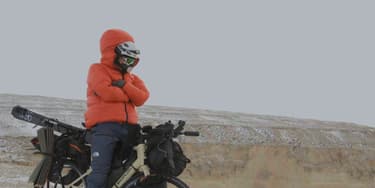
You've been travelling for so long now, when did you realise that you were really on your way to Kyrgyzstan?
It took us 20 days to get from Zurich to Istanbul. The bike weighs 47 kg, and we were travelling so fast that I didn't really realise anything. We were in a new country every other day. 20 days for 10 different countries. Then came the accident, and I was suddenly in the hospital. Two completely different worlds in terms of speed. Somewhere on the border with Georgia, I realised: OK, now we're really going to Kyrgyzstan.
Is there a thought that has stayed with you since day 1?
That's a good question. On the one hand, there's certainly the question of when we'll finally go skiing. We actually wanted to go skiing in the Balkans at the beginning of December, but there wasn't enough snow. I suffered severe neck trauma in my accident, and I was wondering whether I would make it to Kyrgyzstan in time. Then I might not be able to ski there either; I don't have time in Georgia either. So, since day one, the question in my head has been: when am I going to ski?
What did people in Europe and Central Asia ask you most when they heard about your trip? Is there a difference?
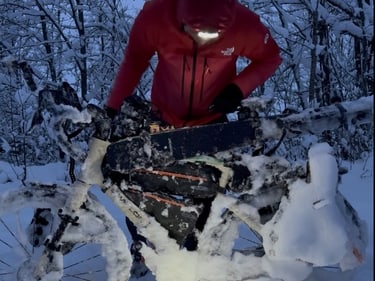
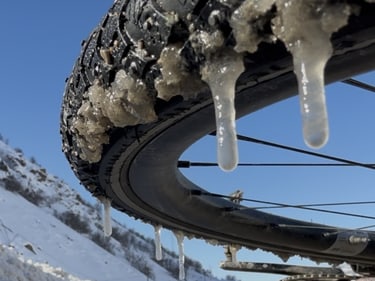
In Innsbruck, for example, many people ski. They were totally enthusiastic about it and always said: Wow, travelling to Kyrgyzstan on skis - that's amazing. They had huge respect for our plans and were mainly interested in skiing. Where I am now, people often have no connection to skiing. But they know that I travelled here from Switzerland by bike. Above all, they have respect for all the camping in sub-zero temperatures. The people there live at temperatures between minus 10 and minus 15 degrees and have to deal with the weather themselves. The further I travelled towards Asia, the more respect people had for the temperatures.
You had an accident in Turkey, what happened?
We were travelling slightly downhill on a small, single-lane road. There were a few cars on the right-hand side. I was still thinking: Oh, I shouldn't drive too close to them, because the door might suddenly open. So I drove in the centre of the road, at about 20 km/h. And then suddenly one of the parked cars drove out of nowhere into the middle of the carriageway, and I had no way of avoiding it. I crashed into the car with my right shoulder. My neck took the brunt of the impact. The person in the car and I then tried to talk to each other using Google Translate. Luckily, her good colleague came by, and she spoke relatively good English. We then parked the bikes there, and the four of us drove to the hospital in the accident car. I was the first foreign patient there, and they didn't really know what to do with me. They took X-rays and did a CT scan, and I was there for two to three hours. In the evening, they drove us back to the bikes.
Wow, luckily you're doing reasonably well!
Yes, fully. I've already had a few minor accidents, so I thought, I'm not doing too badly; we can continue tomorrow. Then we took a day's break. That wasn't enough, and we had to take a longer break. I was then alone in Ankara for three weeks while my colleague travelled on. I was back in the hospital there and did a lot of physio. It was tough being stuck there alone over Christmas and New Year. Then you would actually say to yourself, "Why don't you just go home?" But somehow I found my motivation again, and now I'm back on the road.
Did you briefly consider cancelling the whole thing?
Yes and no. I arrived in Ankara at Christmas and asked myself how many days I could give myself to recover here. In my head, that was three weeks, until mid-January. It simply had to be realistic for me to complete the project at any time. These deadlines also helped me to motivate myself. I was back on my bike on 9 January. I was in a lot of pain on the first day, but because I had allowed myself enough rest in between, I was fine.
Has the accident changed his view of risk?
No, not really. I could actually have had the same thing happen to me in Zurich. I wasn't travelling irresponsibly on the road either. You're on the road for 8000 kilometres, so something like that can happen.
The same thing could have happened to me in Zurich.
Back on the road, what does a typical day on the bike look like for you, from getting up to going to bed?
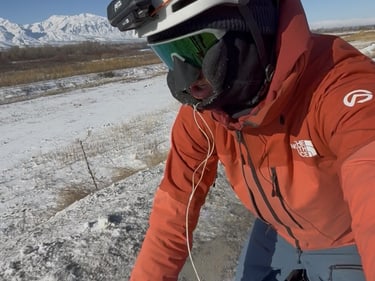
Pretty stressful (laughs). My average speed. I currently manage around 100 kilometres a day. That means ten hours on the bike. I usually get up early at around 5 am. In the morning, I need about 1.5 hours to pack everything up. Then I try to be on my bike 30 minutes before sunrise. I try to ride without stopping as long as I can. Of course, I also have a snack on the bike. So, after about six to seven hours, I take a break and eat something warm somewhere, if possible. Then I cycle for another three to four hours. Then it's time to find somewhere to sleep and organise food. In the evening, I edit videos and talk to my girlfriend or family on the phone. Then I go to bed at around 20:30.
What do you completely underestimate when you imagine a trip like this?
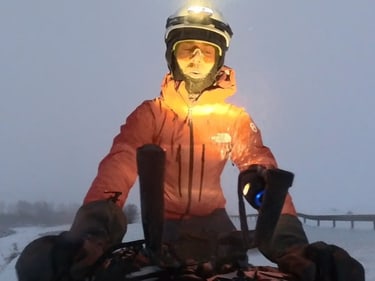
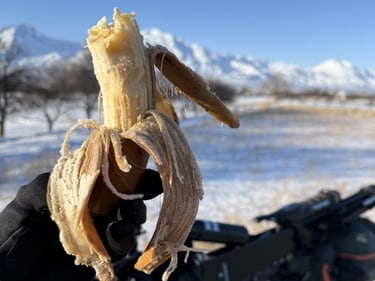
I think the hours you don't spend on the bike are spent sleeping. I'm often stressed to the max and have to organise lots of things, charge devices, or plan overnight stays. You have to imagine: I have 12 different electronic devices. The biggest challenge at the moment is sitting on my bike at minus ten degrees. The air is incredibly cold and dry. Now I've been able to buy a professional mask in Georgia that humidifies the air when I breathe. But all in all, it's the stress of the day that I underestimated the most. Or when you're on your bike and suddenly have to go to the toilet at minus 15 degrees (laughs).
What do you miss most about home and what don't you miss at all?
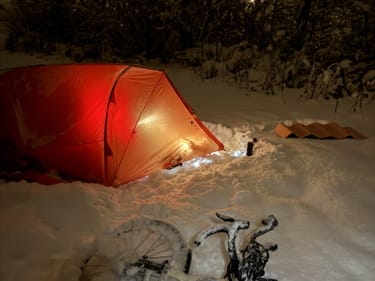
Yes, my girlfriend or my colleagues. Just sitting together and talking. It's quite special when you're travelling alone so much. But I don't feel lonely because I meet so many people every day. Surprisingly, I don't miss my bed at all. My favourite place to sleep is on my mat. At the moment, I don't shower every day, but I don't miss it either.
You are about to enter the Kazakh desert. What are you most looking forward to, and what do you respect?
I'm really looking forward to the landscape. And the absurdity of travelling there with my bike, skis, and ski boots. Travelling through the desert on a bike with ski equipment - the most stupid thing you can do! I've never been in such an extreme desert. I have respect above all because of the water situation. There's no snow that I could melt. What's more, I don't know what the road conditions will be like for about 150 kilometres in the middle. You can't see a road on Google Maps. So it's a mixture of anticipation and respect.
I have particular respect for the water situation.
How does the landscape, the mood and your head change the further east you go?
Exciting question. From Slovenia and Croatia onwards, it became really special for me, because I'd never been to these countries before. In the north of the Balkans, it got really tough. We had bad weather, and the landscape and atmosphere were rather dreary. From Turkey onwards, people laughed a lot again. We met some great people there. My Turkish is now even at A1 level (laughs). Georgia is now culturally very different again. In my head, however, it feels more and more like I'm heading in the right direction every day.
Did you meet anyone on your trip who particularly touched or surprised you?
Yes, this guy I met on day 68. It was minus 15 degrees, I was there with my mask on my bike and suddenly I saw a guy on his horse. Normally, only trucks or cars pass me because it's just too cold. He then came up to me and we talked together. He was super friendly. I then told him that I was travelling to Kyrgyzstan and he gave me his cap.
What has this journey taught you about yourself so far?
I've always felt I'm not the most patient person. But I have realised that I can actually do it. This journey has also been characterised by optimism. I often had physical problems. But I also learnt to look for solutions rationally and actively. I realised more and more that it always goes on and, at its worst, it's just a good story.
Apart from the accident, what was your most extreme experience so far?
The last village in Turkey was crazy. I arrived there at 8 pm, after ten hours on my bike. There was only one hotel in the whole village, but it was closed. There was an incredible amount of police and military - only one of three people was a civilian. I wasn't allowed to pitch my tent anywhere. It was minus 20 degrees at night. I was then invited into the staff area of a bakery. After half an hour, they realized it wasn't so cool after all and called the police. I then had an hour-long interview. They wanted to know what my mission was because they were afraid that I was a refugee. I ended up in a café at 10 o'clock in the evening. I was allowed to sleep on the floor there. Everything was dirty. I unrolled my mat at 11.30 pm and slept for another 6 hours. I was at my limit then. I really had to try and stay optimistic.
Sie hatten Angst, dass ich ein Flüchtling bin.
If you had to summarise the journey in one sentence, what would it be?
I think so: "Somehow it always goes on".
What would you say to someone who is dreaming of such a great adventure but is not yet ready?
Just do it. It's important to think in stages. Certainly not get up on the first day and think: Oh, now I still have 8,000 kilometres to go.
What are you taking with you from this trip, regardless of what happens next?
So far, I'm taking everything back with me, except skiing (laughs). But it's also kind of funny. But the many encounters with people will certainly stay with me. So many people have helped me in crazy situations.
Finally: How did you come up with the idea of travelling to Kyrgyzstan by bike to go skiing?
Three years ago, I came across a map of Kyrgyzstan and thought: Wow, that's amazing! Then I saw a video of people skiing there. It looked so beautiful. I then did some research and found that 95% of this country is covered by mountains. I then suggested to a friend that we could go skiing there. But he said he didn't think it would be cool to fly there and ski for a fortnight. We then travelled to Norway. We slept in a tent there for 50 days. After I finished my studies, I thought about Kyrgyzstan again. If you can cycle 3000 kilometres through Norway, you can also cycle 8000 kilometres to Kyrgyzstan.
Follow Simon aka alpine.joker on Instagram to follow his adventure up close!